Metal trusses are important structures widely used in construction to create strong and stable frames for buildings, bridges, hangars and other structures. The manufacture of metal trusses begins with design, which takes into account all loads, climatic conditions and operational requirements. The main materials for their manufacture are steel and aluminum. Metal profiles (angles, channels, pipes) are cut to specified dimensions, after which the truss elements are welded or connected with bolted joints.
Installation of metal trusses requires high precision and compliance with all safety measures. First, a foundation or support columns are prepared at the construction site. Then the trusses are lifted using cranes and attached to pre-prepared supports. It is important to correctly align the geometry of the structure to avoid distortions and load deformations in the future.
Dismantling metal trusses also requires professionalism. First of all, it is necessary to carefully prepare a work plan, taking into account possible risks. Dismantling begins with dismantling auxiliary structures, after which the trusses are carefully removed and lowered to the ground. After this, the elements can be disposed of or reused, depending on their condition.
Thus, the manufacture, installation and dismantling of metal trusses are complex processes that require a professional approach, precision and compliance with all technological norms and standards.
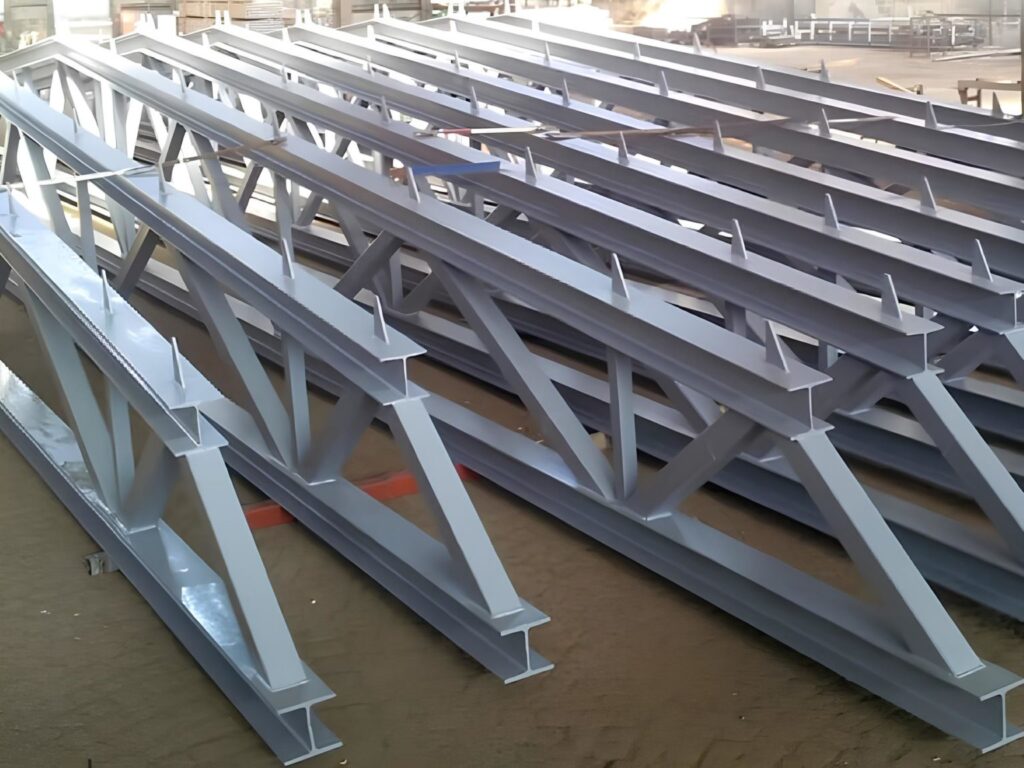

There are several main types of metal trusses, differing in shape, structural features, and application areas. Here are the key ones:
- Triangular trusses (single-pitched and double-pitched):
- Triangular trusses are the most common due to their high rigidity and stability. They are often used in the construction of roofs and bridges. Single-pitched trusses have only one slope, while double-pitched trusses have two, forming a classic roof shape.
- Rectangular trusses:
- Rectangular trusses have a simple and convenient design, making them easy to manufacture and install. They are used in industrial buildings, hangars, and warehouses, where large spans without intermediate supports are required.
- Arch trusses:
- Arch trusses have a curved shape, providing them with exceptional strength and allowing them to cover large spans without intermediate supports. These trusses are commonly used in sports facilities, hangars, and domed buildings.
- Polygonal trusses:
- Polygonal trusses consist of several straight sections connected at an angle, giving them high stability. They are used in structures with large spans and where significant loads need to be supported.
- Trapezoidal trusses:
- Trapezoidal trusses have a trapezoid shape, offering high stability with less material usage. They are often employed in the construction of bridges and roof coverings.
- Parallel chord trusses:
- These trusses have upper and lower chords that run parallel to each other. They are used in buildings with flat roofs and in the construction of multi-story structures.
Each type of metal truss has its own characteristics and is used depending on the structural requirements, loads, and architectural features of the building.